
What “Commit” Actually Means
Notes from 30 Years of Relationship
Thirty years ago this week, when we were in the spring semester of our first year of undergrad studies, an ethnically Chinese man who immigrated to the United States as a young boy and I (a fourth-generation Clevelander on my maternal line, with each woman having married a man whose first language was not English) decided to figure out what we could become to each other.
We had our first kiss, outside my Psychology 101 classroom, on April Fool’s Day.
Twenty-six of those years we have been legally married.
In that time, I have given birth to our five sons )the oldest two now young adults, the youngest still in elementary school), welcomed his parents into our home, navigated disabilities, financial chaos, cultural collision, and the particular exhaustion of loving someone across multiple aspects of intersectionality.
We have had years of ease and years of genuine misery.
And somewhere in the last twelve months — after a long downward spiral I intend to be honest about in much more detail eventually — we turned something around.
I want to tell you what turned it, and this series of seven sacred-to-us mini-essays that might grow into a book on Stoic marriage will get into some of that.
But first, I want to talk about a word, because the word has been doing a lot of damage.
I. The Word Itself
Commit comes from the Latin committere — com, meaning “together with,” and mittere, meaning “to send” or “to entrust.” The same root gives us mission, transmit, permit, and message. At its oldest, “to commit” did not mean to lock yourself into a cage. It meant to entrust something precious to another’s keeping. To send yourself — your vulnerabilities, your future, your daily irritations, your 2 A.M. fears — together with another person, into a shared life.
Most of us were taught a different meaning. We were taught commitment means staying even when you don’t want to. That framing turns it into an act of will against desire, which eventually makes it feel like a prison sentence; or as a rabbi friend recently relayed, some people view following commandments as a form of enslavement. This is how strong the modern fear of commitment has become, through its being polluted by popular culture. The older meaning turns it into an act of trust, which is something you can choose to practice daily, even when the feeling isn’t there (yet).
What life has taught me (repeatedly, and not infrequently the hard way due to my innate stubbornness) is that in order to get to the delicious, nourishing fulfillment of authentic intimacy, we need to be in a fully committed relationship with someone we know in our bones won’t ghost us.
I have spent about four decades thinking about the difference. I had reasons to start early.
II. Learning From Absence
My father left his marriage to my mother for another woman when I was two years old. I was raised, consequently, in a world where commitments were contingent — honored until they became inconvenient, real until a more appealing option appeared. That is not a verdict on my father as a person. It is simply what I absorbed about how the world worked.
What this does to a child’s nervous system is not subtle.
Through my studies of social sciences and neuroscience, I have come to the firm conclusion that there is no authentic intimacy — no state where your nervous system can actually rest and reset in another person’s presence — when there is no foundational trust that the person will still be there tomorrow.
Without commitment in the older sense, the body never fully arrives in the place of sanctuary where it can fully become. Part of the nervous system stays near the door, one hand on the frame, just in case a quick escape is necessary for survival.
I did not have language for this when I was young. I just knew, very early, what I was looking for in relationships, and not just romantic ones, thanks to the commitments unrelated others honored with me when it wasn’t their job to do so.
I was lucky to have some truly excellent neighbors, who committed to being present in my young life as much as circumstances allowed. I was able to rest, reset, and grow because of them.
III. Recognizing It When I Saw It
Six weeks after Garvin and I became a couple, he left.
Not the relationship; just the state, due to a prior commitment.
Before he had ever expressed romantic interest in me (which he genuinely expected would not be reciprocated), he had made a commitment to spend the summer working as a staff member at Camp Jened, a summer camp for people with disabilities in upstate New York that had been a seedbed of the American disability rights movement since the 1970s (and which many people know now from the Oscar-nominated 2020 Netflix documentary Crip Camp: A Disability Revolution). The pay, after housing expenses were deducted, from what I remember him telling me at the time, came out to something under two dollars an hour (in 1996 money).
He had made the commitment before we were a couple. He honored it anyway, even though it took him from my arms at a pay rate lower than he could have gotten if he’d stayed near our university for the summer and couch surfed. We were long-distance for two months at the start of a new and uncertain romance because he had given his word, and his word meant something to him independent of what it cost him.
I was nineteen years old, and I recognized what I was looking at.
The ancient Stoics (practitioners of a Greek philosophy that is much less about emotional suppression than popular culture suggests, and much more about understanding what is genuinely in our control and acting well regardless of outcome) have a concept that maps onto exactly what I witnessed in those two months. The Greek word (which, no, I cannot pronounce and yes, I need the internet to help me spell — I include these words for others who need the vocabulary for further learning) is kathêkon, usually translated as “appropriate action” or “proper function.” It means doing what the situation and your own nature as a decent person actually calls for, not what is convenient, comfortable, or only what will be sufficiently and immediately rewarded. You do it because it is the right thing to do. You do it because you are someone who does this thing. That is virtue, in the Stoic sense — not a feeling, and not a performance, but a practice demonstrated through choices, especially inconvenient, discomforting, or costly ones.
The boy who left for two months to keep a promise to a camp full of people who needed someone like him, for wages that barely covered their own deductions, without any guarantee I would still be interested when he got back? I recognized, at nineteen, that I was watching someone practice virtues worthy of considering aligning the rest of my life plans with. I built a life on what I saw in those two months.
Tonight, thirty years later, we are eating cake with the village I’ve put forth effort to immerse our family in for the last decade.
IV. What Atrophy Looks Like
Here is what neuroscience says, in plain language: your brain physically reshapes itself around what you pay attention to. This is called neuroplasticity — “neuro” for the brain and nervous system, “plasticity” meaning it can be molded, like clay.
In a W.E.I.R.D. (Western, Educated, Industrialized, Rich, and Democratic) society that has engineered away most of the ordinary daily friction that once required us to genuinely need each other, most of our attention is routed outward — to screens, to work demands, to logistics, to the thousand small urgencies that feel impossible to ignore. When we do have time together, we often sit side by side watching other people live curated versions of lives on a screen.
There is nothing wrong with watching television together, in moderation. But it is not, on its own, true connection — though it can lead to deeper connection if it serves the role of sparking meaningful conversations. The neural pathways that carry the felt experience of fully loving and being fully loved within any kind of relationship will, without regular use, quietly narrow.
You will not stop loving them.
You will simply stop feeling it much.
And then someone will ask if your marriage is fulfilling you, and you will hear yourself say “not really,” and the advice you receive from well-meaning people will, I suspect, almost certainly be wrong if the goal is honoring commitments and deepening intimacy.
V. The Practice of Micro-Moments
Barbara Fredrickson, a researcher at the University of North Carolina at Chapel Hill, calls the basic unit of real connection a micro-moment of positivity resonance — a shared moment of warmth, eye contact, or synchronized attention between two nervous systems. These moments are not grand. They are ten seconds of eye contact over coffee. A hand on a shoulder in passing. A joke only the two of you understand.
She found that these micro-moments are not merely emotionally pleasant; they are physically and mentally health-protective, measurably so over time. They accumulate. They build the neural infrastructure that makes it possible to feel, in the middle of a stupid argument about who forgot to put something absolutely essential and needed for the next day on a shopping list for a store that closed five minutes ago, that you are still fundamentally safe with this person.
A marriage does not drift because the love runs out. It drifts because the micro-moments stop, and the nervous systems stop knowing how to find each other in moments of distress. The drift is not a verdict. It is an atrophy of skills from a decay of connection, and that can be healed with appropriate interventions.
Last year on this day, I gave my husband a book as an anniversary gift: organizational psychologist Tasha Eurich’s Shatterproof, which had just been released. The concept at its center — that we each have resilience ceilings we don’t know about until we hit them — opened a door for my husband that had been stuck for a long time. It led him to finally deeply engage with Matthew Fray’s This Is How Your Marriage Ends (which I’d been trying to get him to read for at least a year at that point) and to join the support groups Matt runs. My husband began attending those twice-weekly support group meetings as his schedule allowed at the end of last school year. It led us to reading Terry Real’s work together after my husband found a New York Times interview that caught his attention — several of Real’s audiobooks had been sitting in my collection for years, patiently parasocially accompanying me in my waiting. Real’s words in Us helped us understand one another better; his I Don’t Want to Talk About It broke something open within my husband that finally let some of his light shine through again, including ending his decades-long lapse in writing poetry.
I tell you this not to perform vulnerability, but because one of the most persistent myths about long marriages is that the good ones don’t need outside help. The truth is that the ones that last are the ones where at least one person keeps reaching — for a book, for support from others who know the struggles, for a framework, for anything that might reopen a door.
VI. The Architecture of Daily Return
The practices I started building into our days as our wounds from a string of ruptures started to heal are small ones practiced frequently, which is necessary for neuroplasticity to do its work. Relationship researcher John Gottman calls these “bids for connection” — small reaches toward another person that say I want to feel closer to you right now. His research found that couples who responded to these bids about 86% of the time were still together years later. Couples who responded about 33% of the time were not.
We have established several micro-rituals that are consistent bids for reconnection.
One is that I set my alarm ten minutes earlier than I need to get up. That snooze time is exclusively reserved for the opportunity to cuddle — no phones, no talking about the day yet, just we are here, we are warm, the day hasn’t gotten us yet. Sometimes our youngest joins in, three spoons nested together in a big, warm bed.
Additionally, when either of us are exiting the shared audiological space, even just to go to a different floor of the house, we make brief physical contact as a way of taking leave. A hand squeeze. A shoulder touch. A kiss on a forehead. Just enough to register as: a trace of me will still be here within your nervous system until I return.
Another quirk of our relationship is that I only say “I love you” to my husband (and only my husband) in German — ich liebe dich.
My parents were each half German, so the majority of my ancestors spoke that language, and everything those ancestors endured to bring me into existence happened in and around that language. When I reach for those words instead of the English ones I use with everyone else who sparks feelings of affection within me, I am leaning into all of that — the survival, the displacement, the stubborn persistence of bloodlines across catastrophes across history.
Those words, in their language, remind me that whatever is irking me about my husband on any random day is a modern triviality, not a feature of his core humanity. Their language keeps me from committing the Fundamental Attribution Error every time I use it to remind myself that this is the person I have chosen to throw in with for the rest of our lives, and that he is worthy of that commitment.
Throwing in with one’s spouse — especially thoughtfully, especially choosing this relationship again and again after years and a long downward spiral — is, I have come to believe, one of the most reliable ways to become a good ancestor to our own lineage.
The Stoics had a word for disciplined daily exercises you perform whether or not you feel like it: askēsis (from Greek, the root of “ascetic” — meaning someone who practices rigorous self-discipline). Love, in the Stoic understanding, is not a state that descends upon you and then abandons you like a strong wind. It is something you practice your way back into, repeatedly, for as long as you are committed — which, if you remember, means as long as you are entrusting yourself to this.
Our youngest son, currently 9 years old, has a ritual he and I built together. It started with me kissing him goodnight in a particular sequence — forehead, cheek, chin, other cheek, nose — and at some point, he decided he wanted to be the one doing the kissing. Now, before he goes to school and before he goes to bed, he approaches me for what our family calls “compass kisses.” North, east, south, west, and center. The whole orientation of the world, in a five-point constellation on his mother’s face.
I did not intend this to be a way for him to show love to me. But he grew up in a house where connection is enacted, not just felt. Where you approach a person you love and make the bid. Where love is a verb practiced at thresholds — at leaving, at returning, at the edges of sleep. He is learning the grammar of relationships. He will know how to initiate it. He will know you do not wait until you feel like it first.
VII. The Village That Holds the Light
No marriage survives on its own internal resources alone. Our ancestors knew this. The village was not a backdrop in front of which life happened — it was infrastructure. It held the stories of what long relationships actually flow like across decades, with their rhythms of ebbs and flows. It offered repair wisdom from people who had already been lost in the same kind of darkness we feel stuck in, and quietly applied a kind of social pressure that made leaving feel less casually available as an option when things got hard.
We have largely lost that. What has partly replaced it in popular culture — the steady diet of televised marriages in crisis, relationships performed for drama and ratings — does the polar opposite. It trains our negativity bias on other people’s worst moments and offers those moments as the primary available template for what partnership looks like over time, while hiding the true costs of leaving when things are going off-script from the fairy tales. That is not nothing. It is, in fact, quite a lot of damage done very consistently.
Garvin and I have spent more than two decades building what I think of as pseudo-villages into the fabric of our family’s life. One of them is our local chapter of the Society for Creative Anachronism (S.C.A.) — a historical recreation community — whose weekly meeting we have committed to attending together as a family every Wednesday when it is reasonably possible to do so. Over more than a decade of those Wednesdays, we have built intergenerational relationships with people who understand what it means to show up for each other in ways that make life meaningfully less difficult in hard times. These are people who have watched our children grow, who have cooked alongside us, who have been present for the small losses and the quiet celebrations.
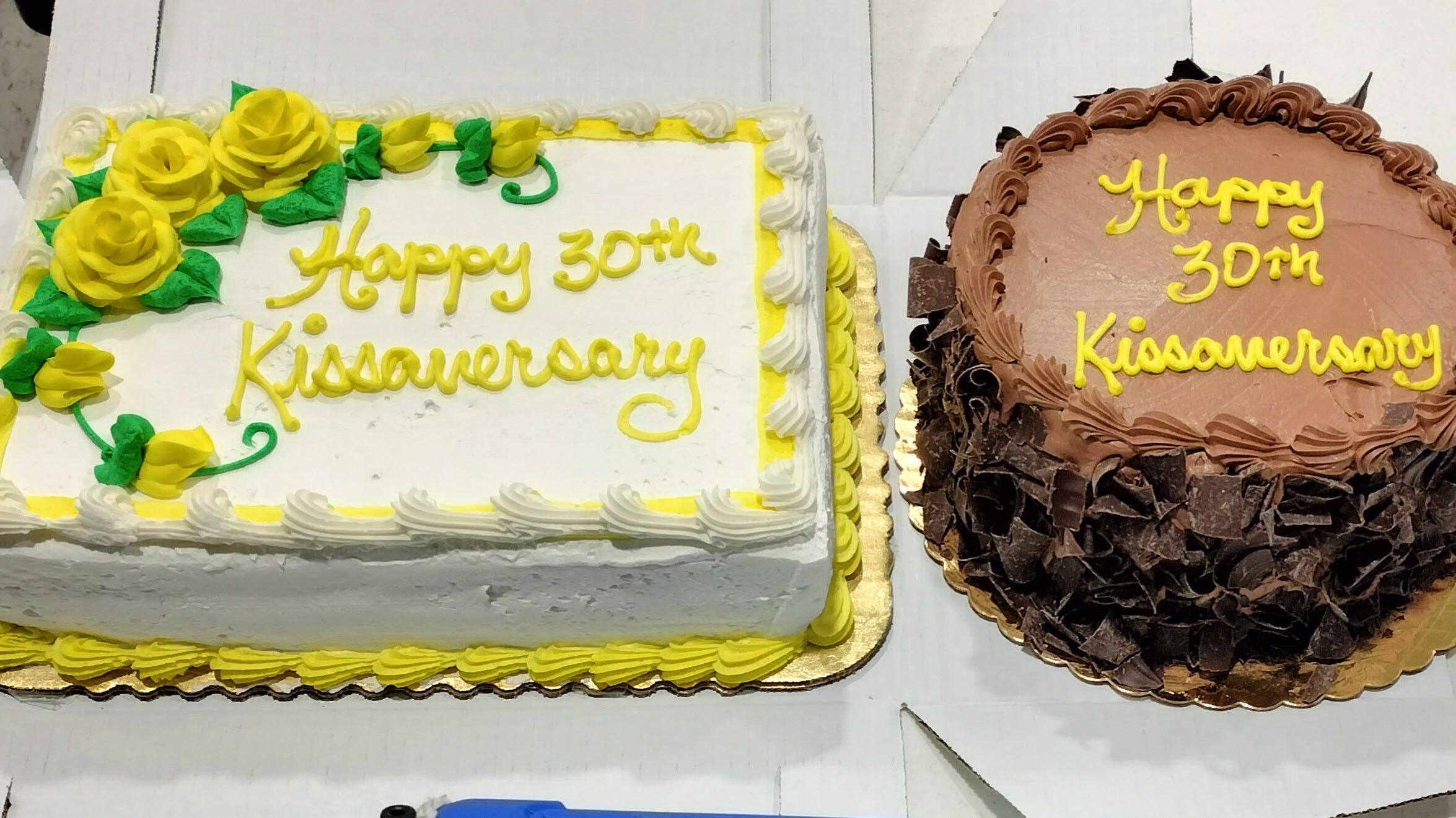
Tonight, thirty years after Garvin and I decided to figure out what we were to each other, we are spending our anniversary in that community. He ordered the cakes (Cleveland Cassata Cake, which is the special occasion cake from my family of origin including being present at our wedding, and Choclate Decadence Torte which strongly resembled the groom’s cake at our wedding except with buttercream instead of ganache), from a bakery, without being asked — which, if you have been reading closely, you will recognize as a bid for connection while also not adding any more to my overfilled to-do list.
I recognized it.
I turned toward it.
It was delicious.
We do not become who we are capable of being alone. We become it in relationship — through the friction and the repair, the micro-moments and the compass kisses, the Wednesday evenings and the thirty years.
Ich liebe dich, Garvin. We’ve been worth every bit of it.
For Further Learning
(prioritizing works available free online and/or in audio)
Crip Camp: A Disability Revolution (2020), dir. Nicole Newnham & James LeBrecht. Currently on Netflix. Camp Jened’s history is also documented at nyccivilrightshistory.org.
Fredrickson, Barbara. Love 2.0 (2013). Research summarized freely at peplab.web.unc.edu. Audiobook available from Hoopla at: https://www.hoopladigital.com/audiobook/love-20-barbara-fredrickson/11576042 (a free service from public libraries).
Eurich, Tasha. Shatterproof (2025); her earlier Insight (2017) about internal and external self-awareness is also highly relevant; both books are widely available in audio from public libraries that use the Libby/Overdrive service.
Fray, Matthew. This Is How Your Marriage Ends (2022). Both the audiobook and ebook are available on Hoopla: https://www.hoopladigital.com/artist/matthew-fray/10419839016 and support communities findable through his website matthewfray.com as well as Substack.
Real, Terrence. Us: Getting Past You and Me to Build a More Loving Relationship (2022). Most of his books are in audio, I Don’t Want to Talk About It and How Can I Get Through To You are available as audiobooks on Hoopla https://www.hoopladigital.com/artist/terrence-real/7393894; The NYT article that caught my husband’s attention was https://www.nytimes.com/2025/05/14/podcasts/family-men-therapy-terry-real.html.
Gottman, John. “Bids for Connection,” freely at gottman.com. The Relationship Cure (2001) is widely available in libraries via the Overdrive/Libby system as audiobooks and ebooks.
Musonius Rufus, “On the Chief End of Marriage.” Written around 100 CE (aka AD). Free translation at iep.utm.edu/musonius, or skip straight to this section narrated by Robin Homer aka Vox Stoica here (it’s forcing an embed instead of just a link):